To understand and gain more information about whom I'd like to use as my target audience for my thriller/horror movie, i have gathered research about the top ten ground breaking horror films. this link takes you straight to the website.
http://www.dreadcentral.com/news/51877/top-10-ground-breaking-horror-movies-all-time
Tuesday, 23 October 2012

Horror Idea For My Final Project
For my idea of the final project, i was thinking of making a thriller/horror as my genre. A young adult(teenager) sits alone at the park bench. the atmosphere is nearly dark with a cold weather. she gets flashbacks of her life and how she's been living. the flashbacks shows that she's clearly a disturbed character thus her flashbacks shows how she was kidnapped as a child and was found in an abandoned barn violated and near death. she uses that as an excuse to turn into a bad character. it made her grow up to become an evil scheming teenager. she tricks other girls to become her friend and leads them into bad life of drugs and sex. she's not satisfied until they all become miserable like her. As for the men, she uses them for sex and their money. she has been with so many boys trying to take their money and break their hearts that she didn't realise earlier enough to take a good look at her unimaginably miserable life. she realises it when sitting at the bench after losing everyone and everything thinking there was someone who was going to rescue her. as she's sat on the bench, she realises too late that there is a big storm approaching and she has to find somewhere to escape buy she has nothing and knows no-one. who would save her?
Final Idea for our preliminary task
For my preliminary task, my group and I decided that we would do something really simple to improve our understanding and experiment on how we could improve towards the final project. We were debating about what was going to happen at first and decided it was best to film a guy walking down the stairs and using different camera angles to keep the audience attracted. then we will make him walk down a corridor towards a door, open it and sit down behind his desk. Then he'll call over the next interviewee and have a short back to back conversation.
Experimenting with Logic pro
 |
| This is a print screen of Logic pro in action |
Logic pro is where you can get original sound from the mac and import directly to your video. i was playing around with different sounds and was very entertaining. I find logic pro so far the best software to get original sound because you can get different music and loop them unto each other, stretch them and repeat them at the same time. :)
Wednesday, 17 October 2012
Premier Pro Experience

This is the production of my preliminary task. Premier pro is a very fun application to use when editing. I really like using premier pro because I learn different stuff all the time. I can import videos in the right format, drag them unto the editing bar and edit. Compared to the first time I used premier pro, i have seen so many improvements in myself using the app. I am not necessarily too familiar with premier pro but, in time I am sure to improve to be even able to overwrite files unto each other to create effect.
OUR PRELIMINARY SCRIPT
The following is my Preliminary task script of interaction between an interviewer and interviewee (interviewee trying to get a job as a bouncer in the interviewer's club). I personally done this as it was part of my planning process for my preliminary task.
Interviewer: Hello, have a seat please.
Interviewee: Yes thank you (both participants shake hands firmly)
Interviewer: (looks at interviewee cv) so barry you want a job at my club as a bouncer?! Barry, what makes you think you're ready for this job
Interviewee:As you can see on my CV it shows that I'm ready and I have enough experience for it.
MIDDAY
Interviewer walks down from stairs to a corridor formally. he opens a door to his office and walks into in, sits down and looks at his sheet looking busy. he calls over the next candidate for the available position.Interviewer: Hello, have a seat please.
Interviewee: Yes thank you (both participants shake hands firmly)
Interviewer: (looks at interviewee cv) so barry you want a job at my club as a bouncer?! Barry, what makes you think you're ready for this job
Interviewee:As you can see on my CV it shows that I'm ready and I have enough experience for it.


Weapons that are or can be used in horror films
The Butcher Knife
The butcher knife is like Basic Killing 101. Every horror movie in the world has a serial killer or villain who uses a butcher knife. This is the kind of weapon that audiences are most familiar with. It's the kind of weapon that has been used time and time again in horror films.
Hooks
For some reason, killers who use hooks are exceptionally scary. Being hooked to death implies something much more cerebral than other weapons. This is perhaps because there aren't too many instances where a person would even encounter a hook.
The Chainsaw
Chainsaw murders seem to have their own cult following. Simply mention the word 'chainsaw' and all sorts of torturous images come to mind. The noise of the chainsaw itself is enough to get theater patrons going. The clamor it produces makes people cringe. Obviously, this method of murdering is used in film to evoke the most shock and awe from audiences.
The Ax Murder
A good hatchet job is pretty easy to come by these days. Hollywood directors love using the ax. In fact, this mode of "disposal" appears to have its own genre. Using an ax to kill someone has a certain lumberjack quality to it. The murderers are usually big, brawny, and full of repressed anger.
Ropes
We shouldn't forget ropes. Not only are ropes for binding the victims in horror films. But they also are used to strangle or hang them. Being killed in this manner is distressing beyond belief. However, it's not usually as scary as something that is particularly bloody.
Bare Hands
Murderers that get the job done with their bare hands are usually extremely angry. There is typically a lot of hand-to-hand combat in films where the bad guy actually touches his prey. In the American version of The Grudge (2004), the Japanese husband drowns his family. Watching him do this is quite disturbing. Most of the time, the murderer doesn't necessarily have any relation to the victim.
Contrived Torture Contraptions
It is the Saw series that brings to mind the contrived torture contraption. Although previous films have used all sorts of items to create terrible imagery, the ones seen in these movies really top the cake. To say that the devices are horrible would be a huge understatement.
Camera Angles which create Tension during a Horror Film
An Extreme Close Up - This shot is used to emphasise something, for example if the close up was of the actions somebody was going through using their hands then it would be emphasising that, that individual was about to do something of important relevence. If it was highlighting the inidviduals hands holding a knife then it would be higlighting then maybe something bad was going to happen involving the knife. The connotation of the image would be violence involving the knife.
Close up - This is where the subject being filmed fills the frame, it is often used to show the emotion felt by the subject being filmed. If for example the subject had just done something of significane and was showing the necessary emotion this shot could be used to connotate that and empahisise the emotion that the individual is feeling at that moment in time.
Dutch Tilt - This is a shot used by which the subject or object being filmed is tilted to an angle. This shot is often used in horror films to represent disorientation and confusion. A tilted shot type such as a dutch tilt often connotates confusion or panic.
Extreme long shot - This is a shot by which the hole setting fills the frame. This shot is often used so that the audience can establish what the setting is, mise en scene ect. This shot is often used in horror films to create atmosphere and tension and to also inform the audience of the creepy setting by which the scene is going to take place.
Medium shot - This shot consists of half of the subjects body , with their costume and face still visible. This can be used to show the surroundings of the individual but also the emotions there are feeling at the same time. It is effectively used in horror films especially when creating tension of somebody coming up behind the subject.
I was doing some research on camera angles and shots that are effective in horror films and i found this information at the guardian website that can help or be useful in our filming genre.
There are many generic camera shots beloved of film directors, which audiences have learned to associate with a particular genre. This is especially true of horror films, so try recreating the fear yourself -without spilling a drop of fake blood.
The "hand grab"
Suitable for all thrillers and chillers. Nothing is easier to shoot than a hand suddenly grabbing something or someone, the rest of the grabber's body out of frame. Janet Leigh's hand grabs at the shower wall-tiles in Psycho; Carrie's hands shoot up through the grave-soil to grab your feet.
The "back of the head" shot
For the arthouse horror. The camera gets in tight to the back of a character's head as he or she walks along. This blank, unrevealing back-of-head, all but dominating the frame, is surprisingly effective in hinting at an enigmatic menace in the person's mind. As used in the Dardenne brothers' The Son, or Josh Appignanesi's Song of Songs - not horror films per se, but unsettling nonetheless.
The "killer's eye view" shot
There's nothing more disturbing than establishing where the victim is, how he (or more probably she) is going to be vulnerable, and then showing the predator's point of view, forcing the audience to see things from the killer's standpoint. The classic version is seeing the swimmer's horribly vulnerable and tasty-looking legs in Jaws. There's also the killer's-eye-view opening to Michael Powell's Peeping Tom.
The "killer in the mirror" shot
Suitable for classic horror, but also available in many variants in films like Bernard Rose's Candyman. The victim goes innocently into the bathroom - and then we see the monster reflected behind them in the medicine cabinet mirror-door!
This is the easiest shot for the amateur to have a crack at. Get your victim to preen themselves in the mirror, blissfully unaware, while your psycho-monster in a Halloween mask crouches low, out of shot. Victim opens bathroom cabinet mirror-door to get toothbrush and actor playing psycho-monster stands up into position where he will be reflected. Then victim closes cabinet mirror and - yikes! - horrible psycho-monster appears in reflection behind her. You could even dub in a violin shriek for a little extra terror ...
Tuesday, 16 October 2012
Second preliminary filming
After watching the finished film my teammate and I realised that we had to film our preliminary task again. Before we started filming, we used a tripod suitable for our camera. we made sure it was safe and stable. it was exciting for me because I love to film. Filming went very well for us because it was just as we wanted it to be. :)
First preliminary filming
Our first filming of our preliminary task didn't go very well because all the filming was done with the camera on a tilted angle. When Dee(my teammate) was filming, she did not realise this as it was her first time filming a short video clip. the camera angle position was poor and after looking back at the finished film made her learn from her mistakes.
Friday, 5 October 2012
Thriller genre research (The Dark Night)
The Dark Knight is a 2008 epic superhero film directed, produced, and co-written by Christopher Nolan. Based on the DC Comics character Batman, the film is the second part of Nolan's Batman film series and a sequel to 2005's Batman Begins. Christian Bale reprises the lead role of Bruce Wayne/Batman, with a returning cast of Michael Caine as Alfred Pennyworth, Gary Oldman as James Gordon and Morgan Freeman as Lucius Fox. The film introduces the character of Harvey Dent (Aaron Eckhart), Gotham's newly elected District Attorney and the consort of Bruce Wayne's childhood friend Rachel Dawes (Maggie Gyllenhaal), who joins Batman and the police in combating the new rising threat of a criminal mastermind calling himself the "Joker" (Heath Ledger). The Dark Knight was released on July 16, 2008 in Australia, on July 18, 2008 in North America, and on July 24, 2008 in the United Kingdom. Considered one of the best films of the 2000s, the film received highly positive reviews and set numerous records during its theatrical run. With over $1 billion in revenue worldwide, it is the thirteenth highest-grossing film of all time, unadjusted for inflation. The film received eight Academy Award nominations; it won the award for Best Sound Editing and Ledger was posthumously awarded Best Supporting Actor. The Dark Knight Rises, the final part of a trilogy, was released on July 20, 2012.


THRILLER MOVIE "INCEPTION"
Inception is a science fiction/ action heist film. It was made in 2010 and written, co-produced, and directed by Christopher Nolan. The film stars a large ensemble cast that includes Leonardo DiCaprio,Ken Watanabe, Joseph Gordon-Levitt, Marion Cotillard, Ellen Page, Tom Hardy, Dileep Rao, Cillian Murphy, Tom Berenger, and Michael Caine. DiCaprio plays Dom Cobb, a thief who commits corporate espionage by infiltrating the subconscious of his targets. He is offered a chance to regain his old life as payment for a task considered to be impossible: "inception", the implantation of another person's idea into a target's subconscious.

In 2001, Nolan wrote an 80-page treatment about "dream stealers" and presented the idea to Warner Bros. in a story envisioned as a horror film inspired by lucid dreaming. Feeling he needed to have more experience with large-scale film production, Nolan retired the project and instead worked on Batman Begins which was made in 1005, The Prestige in 2006, and The Dark Knight in 2008. He spent six months polishing the script before Warner Bros. purchased it in February 2009. Inception was filmed in six countries and four continents, beginning in Tokyo on June 19, 2009, and finishing in Canada on November 22, 2009. Its official budget was US$160 million, a cost which was split between Warner Bros and Legendary Pictures. Nolan's reputation and success with The Dark Knight helped secure the film's $100 million in advertising expenditure, with most of the publicity involving viral marketing.
Genre Research (Thriller)
Thriller is a broad genre of film, television, and literature programming that uses suspens, tension and excitements as the main elements. Thrillers heavily stimulate the viewer's moods giving them a high level of anticipation, ultra-heightened expectation, uncertainty, surprise, anxiety and/or terror. Thriller films tend to be adrenaline-rushing, gritty, rousing and fast-paced. Literary devices such as red herrings, plot twists and cliffhangers are used extensively. A thriller is villain-driven plot, whereby he or she presents obstacles that the hero must overcome. The aim for thrillers is to keep the audience alert and on the edge of their seats. The protagonist in these films is set against a problem – an escape, a mission, or a mystery. No matter what sub-genre a thriller film falls into, it will emphasize the danger that the protagonist faces. The tension with the main problem is built on throughout the film and leads to a highly stressful climax. The cover-up of important information from the viewer, and fight and chase scenes are common methods in all of the thriller subgenres, although each subgenre has its own unique characteristics and methods.

Saw (Horror film)
Saw is a horror franchise distributed by Lions Gate Entertainment and produced by Twisted Pictures that. Saw consists of seven films and two video games. The video game was published by Konami. The franchise began with the 2003 short film which was created by Australian director James Wan and screenwriter Leigh Whannell to help pitch as a potential feature film. This was successfully done in 2004 with the release of the first feature film at the Sundance Film Festival. It was released theatrically that October. The sequels were directed by Darren Lynn Bousman, David Hackl and Kevin Greutert, and were written by Wan, Whannell, Bousman, Patrick Melton and Marcus Dunstan, and have been released subsequently every October, on the Friday before Halloween. Both of the creators remained with the franchise as executive producers. On July 22, 2010, producer Mark Burg confirmed that the seventh film, Saw 3D, is the final installment of the series. Series creators James Wan and Leigh Whannell are still open to continuing the series, however, if they can do something "different" with the material. The films collectively grossed over $873 million at the box office worldwide. Lionsgate also expressed interest in continuing the franchise in 2012, though it is unknown whether the series will continue with another sequel, or a reboot of the entire franchise.
The franchise revolves around the fictional character of John Kramer, also called the "Jigsaw Killer" or simply "Jigsaw". He was introduced briefly in Saw and developed in more detail in Saw II. Rather than killing his victims outright, Jigsaw traps them in situations that he calls "tests" or "games" to test their will to live through physical or psychological torture. Despite the fact that John was murdered in Saw III, the films continue to focus on the posthumous influence of the Jigsaw Killer and his apprentices by exploring his character via flashbacks.
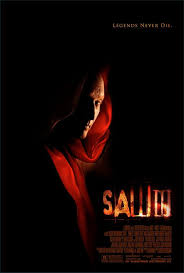
The franchise revolves around the fictional character of John Kramer, also called the "Jigsaw Killer" or simply "Jigsaw". He was introduced briefly in Saw and developed in more detail in Saw II. Rather than killing his victims outright, Jigsaw traps them in situations that he calls "tests" or "games" to test their will to live through physical or psychological torture. Despite the fact that John was murdered in Saw III, the films continue to focus on the posthumous influence of the Jigsaw Killer and his apprentices by exploring his character via flashbacks.
Halloween II (2009 film)
Halloween II is a 2009 American horror film. it was written, directed, and produced by Rob Zombie. The film is a sequel to Zombie's 2007 remake of Halloween (1978), and the second film in the rebooted Halloween film series and the tenth Halloween film overall. Picking up where the 2007 remake ended, and then jumping ahead one year, Halloween II follows Laurie Strode as she deals with the aftermath of the previous film's events. Dr. Loomis who is trying to capitalize on those events by publishing a new book that chronicles everything that happened, and Michael Myers as he continues his search for Laurie so that he can reunite with his sister. The film sees the return of lead cast members Malcolm McDowell, Scout Taylor-Compton, and Tyler Mane, who portray Dr. Loomis, Laurie Strode, and Michael Myers in the 2007 film, respectively.
For Halloween II, Zombie decided to focus more on the connection between Laurie and Michael, and the idea they share similar psychological problems. Zombie wanted the sequel to be more realistic and violent than its 2007 predecessor. For the characters of Halloween II, it is about change. Zombie wanted to look at how the events of the first film affected the characters. Zombie also wanted to show the connection between Laurie and Michael, and provide a glimpse into each character's psyche. Filming primarily took place in Georgia, which provided Zombie with a tax incentive as well as the visual look the director was going for with the film. When it came time to provide a musical score, Zombie had trouble finding a place to include John Carpenter's original Halloween theme music. Although Carpenter's theme was used throughout Zombie's 2007 film, the theme was only included in the final shot of this film.
Halloween II was released on October 30, 2009 to coincide with the Halloween holiiday weekend. the film was released on DVD and Blu-ray with a theatrical version and director's cut of the film offered.

For Halloween II, Zombie decided to focus more on the connection between Laurie and Michael, and the idea they share similar psychological problems. Zombie wanted the sequel to be more realistic and violent than its 2007 predecessor. For the characters of Halloween II, it is about change. Zombie wanted to look at how the events of the first film affected the characters. Zombie also wanted to show the connection between Laurie and Michael, and provide a glimpse into each character's psyche. Filming primarily took place in Georgia, which provided Zombie with a tax incentive as well as the visual look the director was going for with the film. When it came time to provide a musical score, Zombie had trouble finding a place to include John Carpenter's original Halloween theme music. Although Carpenter's theme was used throughout Zombie's 2007 film, the theme was only included in the final shot of this film.
Halloween II was released on October 30, 2009 to coincide with the Halloween holiiday weekend. the film was released on DVD and Blu-ray with a theatrical version and director's cut of the film offered.

Subscribe to:
Posts (Atom)